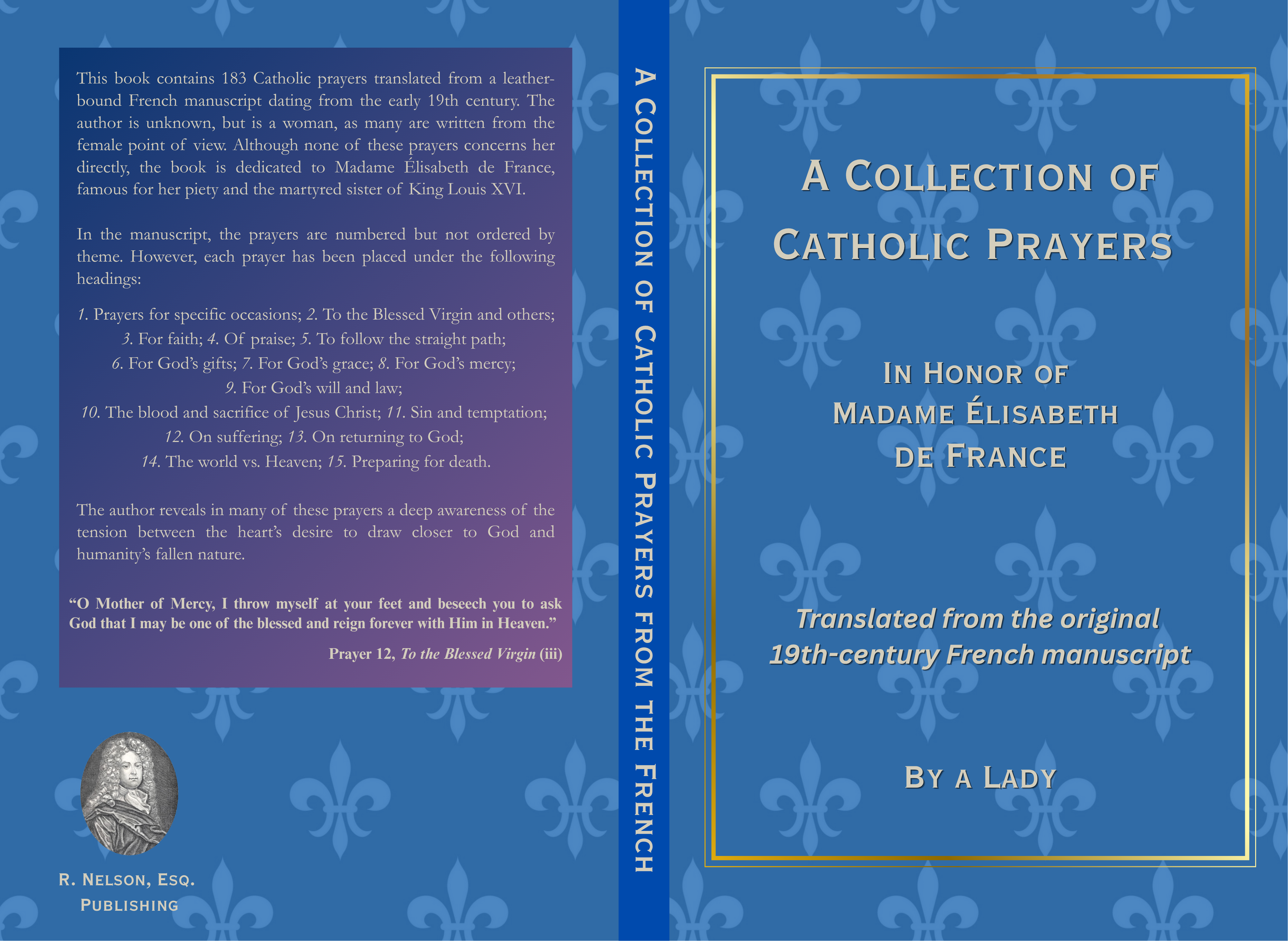
A Collection of Catholic Prayers
in Honor of
Madame Élisabeth
de France
Translated from the original
19th-century French manuscript
By a Lady
Available through:
Amazon in the US in Paperback and Kindle
And in the original French
Amazon in the US in Paperback and Kindle
Table of Contents.
Introduction…………………………………………………………………………………… i
I. Prayers for Specific Occasions (1–9)………………………………………… 1
II. To the Virgin Mary and Others (10–25)………………………………… 14
III. For Faith (26–33)……………………………………………………………….. 26
IV. Of Praise (34–42)……………………………………………………………….. 33
V. To Follow a Straight Path (43–52)………………………………………… 44
VI. For God’s Gifts (53–57)……………………………………………………… 51
VII. For God’s Grace (58–63)…………………………………………………… 55
VIII. For God’s Mercy (64–79)…………………………………………………. 61
IX. For God’s Law and Will (80–89)…………………………………………. 74
X. The Blood and Sacrifice of Jesus (90–103)…………………………….. 84
XI. Sin and Temptation (104–134)……………………………………………. 94
XII. On Suffering (135–151)…………………………………………………… 121
XIII. For Returning to God (152–168)……………………………………. 138
XIV. The World vs. Heaven (169–178)……………………………………. 150
XV. Preparing for Death (179–183)…………………………………………. 159
Index to Christian Themes…………………………………………………………… 163
Introduction.
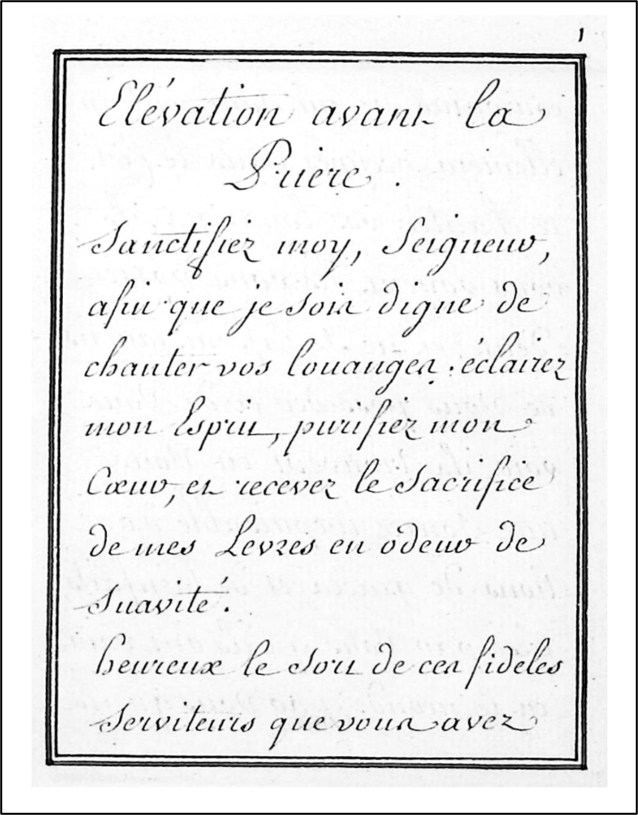
Beginning text of Prayer 1, “Praising God before Prayer.”
Presented in this book is a collection of 183 Catholic prayers transcribed from a leather-bound French manuscript dating from the early nineteenth century. The text is written on laid paper with the watermark of D & C Blauw, a Dutch maker of high-quality paper founded in the 17th century. The author is unknown but female, since many of the prayers are written from a woman’s point of view. Though none of the prayers relate directly to her, the book is dedicated to Madame Élisabeth de France, famous for her piety and the sister of Louis XVI. She was executed by guillotine in 1794.
As seen above, the text, written in a lovely hand, is broadly datable because of its use of older French spelling for words such as the underlined “moy” for “moi,” and eclectic letter forms in which an “r” resembles a “v” (cœur) and an “n” like a “u” (chanter).
In the manuscript, the prayers are numbered but not ordered by theme. The editor has arranged them in fifteen chapters by type, including,
Prayers to the Blessed Virgin and Others,
Intercede for me, Mother of my God, Queen and Mistress of the universe. O Mother of Mercy, I throw myself at your feet and beseech you to ask God that I may be one of the blessed and reign forever with Him in Heaven. (Prayer 12, “To the Blessed Virgin. (iii),” page 15)
For Faith,
O God, the author of all good, increase my faith, make it ever pure, Catholic, orthodox, enlightened, fervent, and unshakeable, so that it is not defeated by the difficulties and obstacles that hinder me on the path of salvation. (Prayer 26, “For an increase in faith (i),” page 26)
Praise,
How can I thank You, O God, for all the good things I have received from You? My soul must eternally glorify You because You are her God and Savior. (Prayer 36, “That my soul may glorify You,” page 34)
God’s Grace,
O Father of light, O divine source of the grace that sanctifies me and of those perfect gifts that make me like You, however imperfectly, deign to share Your gifts and blessings with me. (Prayer 61, “For a likeness to God,” page 57)
God’s Mercy,
O Savior of souls, who redeemed me with Your Blood, will You allow me to perish? Do not abandon me and have mercy on me. Saints Magdalene and Thaïs were sinners like me, yet You saved them. (Prayer 69, “Lord, have mercy on me,” page 64)
The Blood and Sacrifice of Jesus,
I adore You, O Divine Savior, and acknowledge You as my deliverer and my God. Do not allow the Blood You shed for me to be turned against me and do not allow it to be used for my condemnation and ruin. (Prayer 90, “For the Precious Blood of Jesus,” page 84).
In the longest chapter, Sin and Temptation, the author is deeply aware of her sinful nature, and in many prayers, she cries out to God:
Alas, Lord, how cold and indifferent my heart is for you; how vile and fervent for material goods it is, how empty of grace, how full of self-love; how weak, delicate, and sensitive. Give me a pure and new heart, a heart that yearns only for heavenly riches, and finally, a heart that loves nothing more than you. (Prayer 107, “For a pure and new heart,” page 97).
She also acknowledges that she must accept the purifying nature of Suffering:
O God, if only I could see the suffering and afflictions you send me as a blessing, I would both thank you and beg you to add to them the grace to receive them with all the readiness which can make them beneficial for my salvation. (Prayer 135, “Suffering as a gift from God,” page 121).
And finally, when Preparing for Death:
Receive, Lord, this soul You created into Your divine hands whence it came, into those gracious hands that are always guided by mercy, but which only reluctantly yield to the rigors of justice. (Prayer 181, “For the mercy of Jesus Christ when preparing for death,” page 160).
In many of the prayers, the author reveals a profound awareness of the tension between the desires of the human heart to be closer to God and the fallen nature of mankind.
The author dedicates the prayers to Madame Élisabeth de France (1764–1794), the only surviving daughter of Louis, Dauphin of France, and the martyred sister of King Louis XVI. She was very close to her brother and his wife, Marie Antoinette. A devout Catholic from a young age, she lived an ideal early life at Montreuil, near the king at Versailles. Even though she could have gone into exile during the early stages of the French Revolution, she shared the royal family’s trials. In late 1792, the family was transferred to the Tower of the Temple, a prison where they were closely guarded. The king and queen were executed the following year, and their son, the Dauphin, died in 1795 from disease. Their daughter, Marie Thérèse, survived the Revolution and died in 1851.
Below are two prayers, the first was recited daily by Mme. Élisabeth at the Temple prison,
“I do not know what will happen to me today, O my God. All I know is that nothing will happen to me but what You have foreseen from all Eternity. That is sufficient, O my God, to keep me in peace. I adore Your infinite designs. I submit to them with all my heart. I desire them all: I accept them all. I make the sacrifice to You of everything. I unite this sacrifice to that of your dear Son my Saviour, begging You by His Sacred Heart and by His infinite merits for the patience in my troubles and the perfect submission which is due to You in all that You wish and permit. Amen.”[1]
And the other, “A Prayer to the Sacred Heart of Jesus,” given to her by Louise-Marie de Raigecourt, her lady-in-waiting,
“Beloved Heart of Jesus, sanctuary of that love which led God to become man, to sacrifice his life for our salvation, and to make his body the food of our souls, in gratitude for this infinite charity, I give you my heart and with it all that I possess in the world, all that I am, all that I will do, all that I will suffer. But finally, my God, I beg you, may this heart no longer be unworthy of you; make it like yourself, surround it with your thorns to close it off from all disordered affections; establish your cross in it; may it feel its value, may it acquire a desire for it; set it ablaze with your divine flames. May it be consumed for your glory, may it be yours after you have chosen to be wholly his. You are his consolation in his sorrows, the remedy for his ills, his strength and refuge in temptations, his hope during life, his refuge in death. I ask you, O most lovable heart, for this grace for my associates. So be it.”[2]
Notes to this edition:
The editor employed two translation websites, Reverso and DeepL, for a literal English translation. It was then revised into its present form.
The Douay-Rheims Bible, American edition (1899), was used for the biblical passages in the footnotes.
There is an added index of Christian themes employed by the author.
[1] “It has been long supposed that this prayer, known as ‘Mme Elizabeth’s prayer,’ was composed by her, but in a manuscript book which belonged to the Duchesse de la Rochefoucauld a copy has been found inscribed as follows: ‘Prayer composed by the Bishop of Beauvais, and which Mme Elizabeth, sister of Louis xvi., recited every day.’ We may therefore conclude that it may originally have been given to the Princess by its author.” Maxwell-Scott, H. M. (1908). Madame Elizabeth de France 1764-1794. London: Edward Arnold, 151–152.
[2] “Prière au Sacré Cœur de Jésus.” Ferrand, Antoine (1861). Éloge Historique De Madame Élisabeth De France Suivi De Plusieurs Lettres De Cette Princesse. Paris: Librairie D’adrien Le Clere et cie Imprimeurs De N. S. P. Le Pape Et De L’archevêché De Paris., 260.

