
An original Charles Dana Gibson drawing. [For more information about this drawing, please contact Fred Taraba at Taraba Illustration Art, https://www.tarabaillustrationart.com/]
To track down where a Charles Dana Gibson drawing first appeared is sometimes easy and sometimes maddening. What period is it? [For dating a drawing, a knowledge of women’s fashion and hairstyles is helpful.] Is it a cartoon or a story illustration?
The first place to look is the online issues of Life magazine, where he drew mostly cartoons (single images not associated with a story, often with a caption) and some story illustrations, from 1886 to 1930, with some breaks. For example, https://www.google.com/books/edition/Life/hklHAQAAMAAJ?hl=en&gbpv=1&dq=gibson+mitchell+life+new+york&pg=RA1-PA212&printsec=frontcover.
Then there are the “Gibson Books,” large, oblong collections of his previously published drawings, both cartoons and illustrations, that were published nearly annually from 1894 to 1906. I checked two later collections, Other People (1911) and New Cartoons (1916) since, stylistically, the drawing dates from between 1910 and 1915. During this period, Gibson mostly drew illustrations for magazine stories (later published in book form), and the majority were by Robert W. Chambers, such as “The Common Law” and “The Streets of Ascalon.” All the stories were set in modern times, so looking for historical dress, etc. was not possible. What makes this drawing tricky is that many of the scenes Gibson drew involved a young man and woman sitting or standing over a table, e.g.
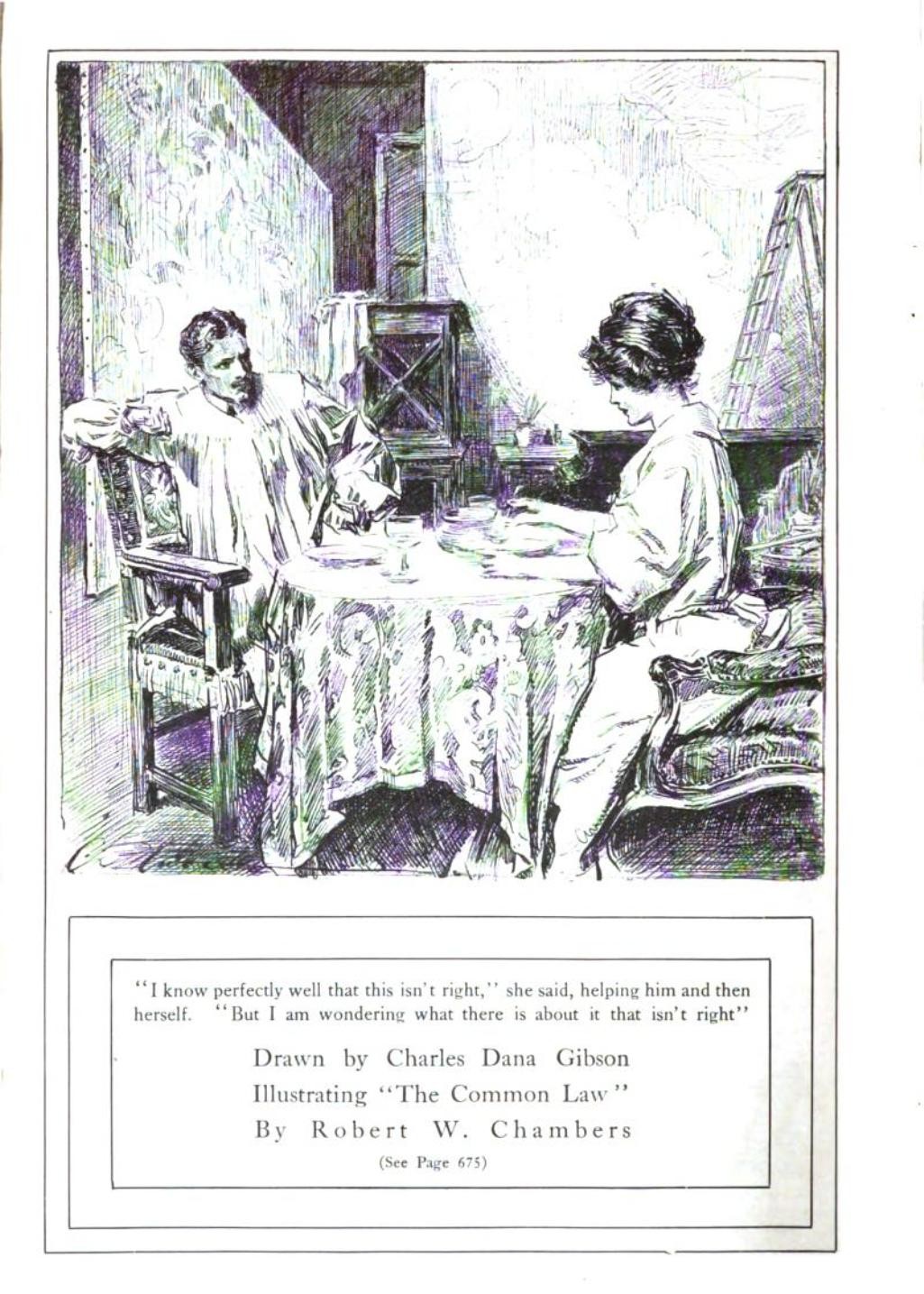
“The Common Law“, November 1910, Cosmopolitan magazine.
Using my guide on his story illustrations, Charles Dana Gibson: A Record of Illustrations for Magazine Articles & Stories, and for Books, I looked in the “Chronological Index” for a listing of stories published during this period, and then checked for images in Google Books: https://books.google.com/advanced_book_search
After checking the various magazines, I couldn’t find the image. Possibly it was a cartoon rather than an illustration, so I looked at issues of Life and Collier’s and didn’t find it either.
I had neglected to look at the two short stories by Chambers he had illustrated for Harper’s Bazar, “The Orange Puppy” and “Stranger than Fiction.” No luck there, but I noticed Gibson did occasional cartoons for the magazine and found this image. Yippee!

“Getting Acquainted–Drawn by Charles Dana Gibson.” Harper’s Bazar, August 1913, p. 2.
What is fun about seeing an original Gibson drawing is that, sometimes, there is information not found in the reproduction. You can see his pencil underdrawing, which he did before inking. It wouldn’t be visible in the reproduction.

Artists would often give the original drawings away to friends and colleagues. He inscribed this work, “To Flagg from C.D. Gibson.” James Montgomery Flagg, creator of the well-known Uncle Sam posters of World War I, was also a very famous illustrator.
What is very unusual is the penciled text at the bottom:
“Their First Misunderstanding— Signs of Forgiveness— The Returning Smile.”
These were test captions for the drawing, none of which were used, and look to be in Gibson’s hand.These were test captions for the drawing, none of which were used, and look to be in Gibson’s hand.

